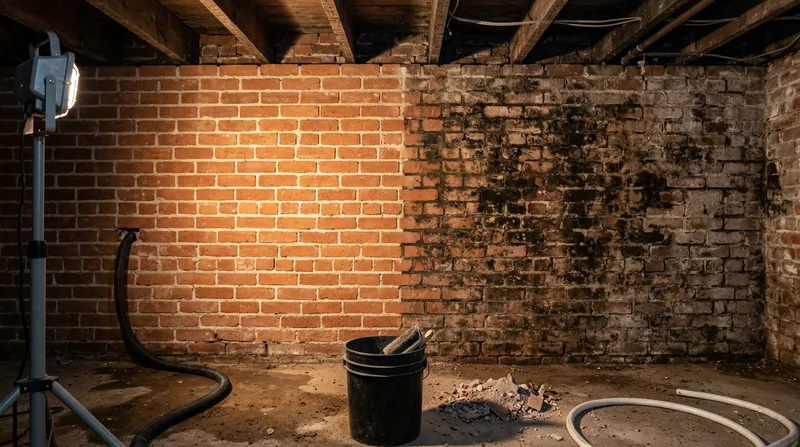




Richmond sits on the Fall Line, where the James River drops over granite rapids and the ground changes from Coastal Plain sands and clays on the east side to Piedmont red clay and saprolite on the west. That geology matters inside your basement. In Church Hill and the Fan, 1840s to 1910s brick rowhouses sit on old brick or granite foundations laid in soft lime mortar, and those walls wick groundwater all summer. Out in Short Pump and Midlothian, 1990s to 2020s Colonials have poured-concrete basements that stay damp when the water table rises after a Gulf remnant or a July thunderstorm. Basement Mold Remediation in Richmond means two things done together: we treat the mold that is already growing, and we fix the moisture source that keeps feeding it. Richmond Waterproofing is a Basement Health Association (BHA) member, and we work below grade only, on the foundation and the basement. If your basement smells musty after rain, start with a free basement inspection so we can trace the water before we touch a single surface.
Why Basement Mold Grows So Fast in Richmond's Old Brick and New Concrete Alike
Mold needs three things: moisture, organic material, and still, humid air. Richmond supplies all three for most of the year. Summers run humid for months, and the city's heavy rain events, from afternoon thunderstorms to hurricane remnants like Gaston in 2004, push water against foundations that were never designed for that volume. In the older neighborhoods the lime mortar between bricks is soft and porous, so water moves through the wall itself and shows up as white efflorescence or a dark tide line. In newer construction, the poured walls are tight but the footing drain can clog or the sump pump can fail during the one storm that matters.
- Old brick and granite foundations in Church Hill, Jackson Ward, and the Fan wick water through soft lime mortar and hold it in the basement air.
- Hillside homes on the river bluffs in Forest Hill and Westhampton take surface runoff against the wall after heavy rain.
- 1950s to 1970s brick ranches and split-levels across Henrico and Chesterfield often have a failed or missing vapor barrier that lets ground moisture rise into the room.
- Newer Colonials in Short Pump and Hanover depend on a working sump basin and discharge line, and a dead pump turns a dry basement damp within days.
- Floodplain lowlands in Shockoe Bottom and Manchester sit close to the water table, so hydrostatic pressure pushes water in regardless of how good the grading looks.
In every one of those cases, the mold is a symptom. Kill it without fixing the moisture and it returns with the next humid week.
Key info: A homeowner in Bellevue called us about a musty smell in a 1920s foursquare. The wall looked dry. Our moisture meter found the brick foundation reading 22 percent behind a painted panel, fed by a downspout that dumped at the corner. We treated the affected framing and rerouted the discharge, and the smell did not come back the following summer.
For the official word on mold and moisture in housing, the U.S. EPA's guide at epa.gov/mold is a plain, useful reference for homeowners.
How We Run Basement Mold Remediation in Richmond, From Smell Test to Final Clearance
We do not fog a basement and hand you a bill. Mold remediation only holds when the moisture reading drops and stays down, so our process starts with finding the water and ends with proving the surfaces are dry. That is also why we pair remediation with drainage or dehumidification work rather than treating it as a standalone cleaning job. Here is the sequence we follow on a typical Richmond basement.
- We walk the basement with a moisture meter and a hygrometer and map every wet reading, including the base of the wall, the floor joint, and the rim area.
- We run a musty smell diagnostic to separate active mold growth from old residue and from damp masonry that has not yet bloomed.
- We set up containment with poly sheeting and negative air pressure so spores do not spread into the living space above.
- We remove porous materials that cannot be saved, such as wet drywall, insulation, and cardboard, and bag them for disposal.
- We treat affected framing, joists, and masonry with an antimicrobial and HEPA-vacuum the surfaces and the air.
- We fix the source: sealing wall seepage, repairing a failed drain tile, correcting grading, or restoring a sump pump and discharge line.
- We verify with a final moisture reading and give you a written summary of what was treated and what was corrected.
That last step is the one most homeowners never get from a general cleaning crew, and it is the one that tells you whether the job actually worked.
Key info: In a 1950s brick ranch in Lakeside, the mold was limited to the bottom two feet of a paneled wall. The cause was a clogged footing drain on the uphill side. We removed the paneling, treated the plate and studs, and installed an interior drain tile system tied to a new sump basin. No exterior excavation was needed, and the wall stayed dry through the next hurricane season.
Remediation Approaches We Use in Richmond Basements
Not every mold job is the same, and the right approach depends on how much material is affected and where the water is coming from. The table below shows the four methods we use most often in the Richmond metro and what each one is built for. We choose based on the moisture map, not on a package price.
| Approach | Description | Best for |
|---|---|---|
| Surface treatment and HEPA cleaning | Antimicrobial application on framing and masonry, HEPA vacuuming of surfaces and air, with containment in place. | Light growth on joists and wall faces where the moisture source is already corrected. |
| Contained removal of porous materials | Cut out and bag wet drywall, insulation, and wood that cannot be dried, under negative air pressure. | Finished basements in the Fan or Museum District where a wall has been wet for weeks. |
| Moisture source correction | Wall sealing, crack injection, drain tile repair, grading, or sump restoration to stop the water feeding the mold. | Any basement where the moisture meter shows active water entry, not just old residue. |
| Dehumidification and ventilation control | Sized dehumidifier and air movement plan to hold basement humidity down through Richmond's long humid summers. | Tight poured-concrete basements in Short Pump and Glen Allen that sweat in July and August. |
Most Richmond jobs combine two of these rows, typically a contained removal plus a source correction, because treating the mold without the water is a temporary fix at best.
Basement Mold Remediation Cost in Richmond: What to Expect
Pricing for mold remediation in Richmond starts at From $1,500, and that figure reflects a contained treatment of a limited area with a clear, single moisture source. Real jobs move up or down from there based on how much material is affected and how much waterproofing work the fix requires. A small patch on exposed joists in a Tuckahoe basement is a different job from a finished room in Windsor Farms where drywall, insulation, and framing all have to come out. We give you a written scope before any work starts, and we tell you plainly when simple crack sealing is enough and when hydrostatic pressure means an interior drain tile system is the better answer than exterior excavation.
Several factors drive the number. The square footage and depth of affected material matter most. So does access: a low English basement in Church Hill with a narrow stair is slower to work in than an open poured basement in Midlothian. Whether the moisture fix is a $400 downspout correction or a full perimeter drain changes the total substantially. And urgency matters, because an emergency call after a sump failure costs more than a scheduled job. That is why we recommend getting two or three estimates and comparing scope line by line, not just the bottom line. Our full pricing overview breaks down how each component is priced.
Finding a Basement Mold Remediation Contractor Near Me in Richmond
Mold work and waterproofing are licensed trades in Virginia, and the contractor you hire should be able to show you both a license and a certificate of insurance before stepping into your basement. Ask for references from jobs in neighborhoods like yours, because a 1920s Church Hill rowhouse and a 2015 Short Pump Colonial fail in different ways. Get at least three written estimates and make sure each one states what will be removed, what will be treated, and what moisture source will be corrected. If a quote only lists square footage and a spray, it is not a remediation plan.
Permits are commonly required for structural foundation repair, egress window cutting, and any work that alters drainage or the sanitary connection of a sump discharge. Thresholds vary by jurisdiction, so we always confirm with the local building department before work begins, and we tell you which permits apply to your job. If you are in an HOA, check the architectural review rules before exterior drainage changes. To set up a walkthrough, reach us through the contact page or call (804) 525-9678. We serve homeowners across Richmond, Henrico, Glen Allen, Midlothian, Mechanicsville, and the surrounding metro, and our estimates are free and carry no obligation.
One more thing worth knowing: our warranty is transferable if you sell the home, and we put the terms in writing. We do not promise lifetime coverage, and we do not tell you that groundwater work will change what your house is worth. What we do promise is a dry, verified basement and a clear explanation of what we found and what we fixed.
Basement Mold Remediation in Richmond: Pricing Guide
| Service | Price | Details |
|---|---|---|
| Limited mold treatment with moisture source correction | Starting at $1,500 | Containment, antimicrobial treatment of affected framing or masonry, HEPA cleaning, and correction of one identified moisture source such as grading or a downspout. |
| Contained removal in a finished basement | Starting at $2,800 | Cut-out and disposal of wet drywall and insulation under negative air pressure, plus treatment of the exposed framing and a written moisture verification. |
| Remediation combined with interior drain tile and sump work | On estimate | Full perimeter drainage correction plus remediation, priced after an on-site moisture map because wall length, access, and discharge routing vary widely. |
| Emergency response after a sump failure or flood | On estimate | Same-week extraction, containment, and treatment, priced by affected square footage and how long the water sat before the call. |
| Travel | Included | In Richmond and surrounding metro areas, with no separate call-out or mileage fee added to the estimate. |
| Estimate | Free | On-site moisture inspection and written scope, response within 24 hours at (804) 525-9678, no obligation to book. |
Indicative pricing, the exact cost depends on square footage, finish, and site access. Free personalized estimate within 24h at (804) 525-9678.


