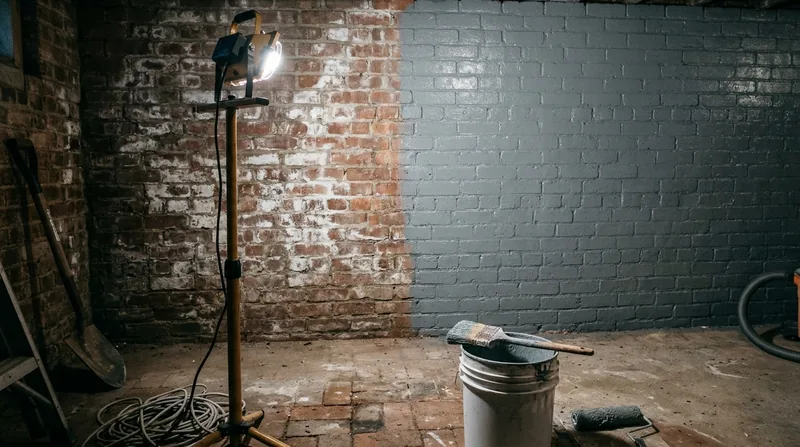




Richmond sits right on the Fall Line, where the James River drops over granite rapids and the ground changes character block by block. East of the city you get Coastal Plain sands and clays with a high water table. West of it you get Piedmont red clay and saprolite that holds water against a foundation wall like a sponge. Add hurricane remnants like Gaston in 2004, heavy summer thunderstorms, and hillside runoff on the river bluffs, and you have a metro where damp basement walls are the rule, not the exception. Basement Wall Sealing in Richmond is the first step for most homeowners dealing with seepage, and it is also the step most often oversold. Our job is to tell you which problem you actually have before anyone touches a wall. If you want the full picture of how sealing fits into a complete system, start with our basement waterproofing service page.
Why Basement Wall Sealing Matters in Richmond's Old Brick and Poured Concrete Basements
The building stock here explains most of the seepage calls we run. Church Hill and the Fan are full of 1840s to 1910s brick rowhouses with English basements and cellars set on old brick or granite foundations laid in soft lime mortar. Those walls were never meant to be waterproof, only thick. Out in Short Pump and Midlothian, 1990s to 2020s Colonials have poured-concrete basements that crack at the cold joint or weep through form-tie holes. In between, the 1950s to 1970s brick ranches across Henrico and Chesterfield develop hairline shrinkage cracks and efflorescence as the block wicks moisture. Sealing addresses the wall surface. It does not address water pushing from behind it.
- Efflorescence, that white chalky bloom on brick or block, tells you water is moving through the wall and evaporating on the inside face.
- Damp patches and a musty smell in summer point to vapor moving through the wall rather than a running leak.
- Spalling brick faces and crumbling mortar joints in Church Hill basements mean the wall has been wet and freezing for decades.
- Water that appears only after heavy rain and disappears in dry spells usually signals hydrostatic pressure, not a surface problem.
If your wall shows any of those signs, a sealer alone is a bandage. We say so on the first visit.
Key info: A homeowner in Forest Hill called us about white powder on a 1920s brick wall. The wall was damp but never wet to the touch. A penetrating sealer and repointed mortar solved it. A neighbor two streets over had a wet floor after every storm, and that one needed an interior perimeter drain, not a sealer. Same city, same brick, different problem.
For the regulatory side, foundation and drainage work in the city is administered by the Richmond Department of Planning and Development Review, and thresholds vary by jurisdiction across Henrico and Chesterfield. Verify before you dig.
How We Approach Basement Wall Sealing on a Richmond Foundation
We start below grade and work outward. The first question is never which sealer to use, it is where the water is coming from. A wall that is damp from humidity and a wall that is wet from a rising water table look similar to a homeowner and completely different to a moisture meter. We map the wall, check the floor joint, look at the grading and downspout discharge, and read the efflorescence pattern before we recommend anything.
- We inspect the full perimeter and identify the moisture source, whether it is surface vapor, capillary rise, or hydrostatic pressure.
- We remove efflorescence and loose parging with wire brushes and a masonry cleaner so the sealer bonds to sound material.
- We repair open mortar joints, honeycombs, and form-tie holes before any coating goes on.
- We apply a penetrating sealer for damp, breathing masonry or a membrane sealer where the wall needs a physical barrier.
- We extend downspouts and correct grading so roof water stops landing against the foundation in the first place.
If the inspection shows pressure, we stop and talk about drainage instead of selling you a coating that will blister off by August.
Key info: On a 1950s brick ranch in Lakeside, the homeowner had already paid for two coats of sealer from another outfit. Both failed within a year because the block was saturated. We pulled the failed coating, installed an interior drain tile system at the footing, and the wall has stayed dry since. The sealer was never the answer.
Sealing Methods We Use and When Each One Fits
There is no single product that handles every Richmond wall. Old lime-mortar brick needs to breathe. Poured concrete in a Short Pump basement can take a membrane. Choosing wrong means peeling coatings and wasted money, so we match the method to the masonry and the moisture reading.
| Approach | Description | Best for |
|---|---|---|
| Penetrating sealer | Sinks into the masonry and blocks capillary absorption while letting the wall breathe. | Damp brick and block walls with no running water |
| Membrane sealer | Forms a flexible physical barrier over the wall face, bridging hairline cracks. | Poured concrete with minor seepage and form-tie holes |
| Parging repair plus sealer | Rebuilds failed mortar and parging before sealing the sound surface. | Old brick foundations in Church Hill and the Fan |
| Crack injection plus sealer | Epoxy or polyurethane injection closes the crack, then the wall is sealed. | Active cracks in poured concrete basements |
| Drainage first | Interior perimeter drain and sump before any coating is considered. | Hydrostatic pressure and water on the floor after storms |
We recommend the least invasive method that actually solves the problem, and we tell you when sealing is the wrong tool.
Basement Wall Sealing Cost in Richmond: What to Expect
Pricing for wall sealing starts at From $1,500 for a straightforward single-wall or partial-perimeter job with surface prep and a penetrating sealer. A full perimeter on a large poured-concrete basement, or one that needs parging rebuilt and cracks injected first, runs higher. The variables that move the number are linear feet of wall, wall height, how much prep the masonry needs, and whether we are working around shelving and finished surfaces. Old brick in the Fan takes more labor than block in Glen Allen because the mortar has to be handled carefully. Getting two or three estimates is smart, and any honest contractor will explain which problem they are solving, not just quote a coating. Our full pricing overview breaks down the ranges by scope.
What to Look For When Hiring a Waterproofing Contractor Near Richmond
Basement wall sealing is easy to sell and easy to do badly. A contractor who quotes a sealer without checking the moisture source is guessing, and you will pay for that guess twice. Ask for proof of licensing and insurance, and ask what happens if the wall is still damp after the coating goes on. Get at least three references from jobs in your part of the metro, because a Church Hill brick cellar and a Short Pump poured wall are not the same job. Confirm who pulls any permit, since structural repair and drainage alterations are commonly permitted and the rules differ between the city and Henrico or Chesterfield. If you are in an HOA community, check the architectural review requirements before work begins. Our contact page is the fastest way to get a free inspection on the calendar.
Basement Wall Sealing Near Me: What Richmond Homeowners Should Know
Searching for basement wall sealing near me usually means you have already seen the white powder, the damp patch, or the musty smell and you want someone who will look before selling. We serve the city and the surrounding counties from the same base, so we know the difference between a Tuckahoe Tudor with a partial basement and a 1920s rowhouse in Jackson Ward with a granite footing. We are a Basement Health Association member, and we treat sealing as one tool in the box, not the whole answer. If the wall needs drainage, we will say so. If a sealer will do the job, we will not sell you a drain.
Basement Wall Sealing in Richmond: Pricing Guide
| Service | Price | Details |
|---|---|---|
| Single wall or partial perimeter sealing | Starting at $1,500 | Surface prep, efflorescence removal, and penetrating sealer on one to two walls, typical of a small brick basement. |
| Full perimeter penetrating sealer | Starting at $2,400 | Complete wall cleaning and sealer application around the perimeter, priced by linear feet and wall height. |
| Parging repair plus membrane sealer | Starting at $3,200 | Rebuilding failed mortar and parging before coating, common on old brick foundations in Church Hill and the Fan. |
| Crack injection plus wall sealing | Starting at $2,800 | Epoxy or polyurethane injection of active cracks followed by a full wall sealer application on poured concrete. |
| Complex or large-scale job | On estimate | Finished basements, high walls, and jobs where inspection shows pressure that needs drainage first require an on-site look. |
| Estimate and inspection | Free | Moisture mapping and a written recommendation at (804) 525-9678, with no obligation to book the work. |
Indicative pricing, the exact cost depends on square footage, finish, and site access. Free personalized estimate within 24h at (804) 525-9678.


