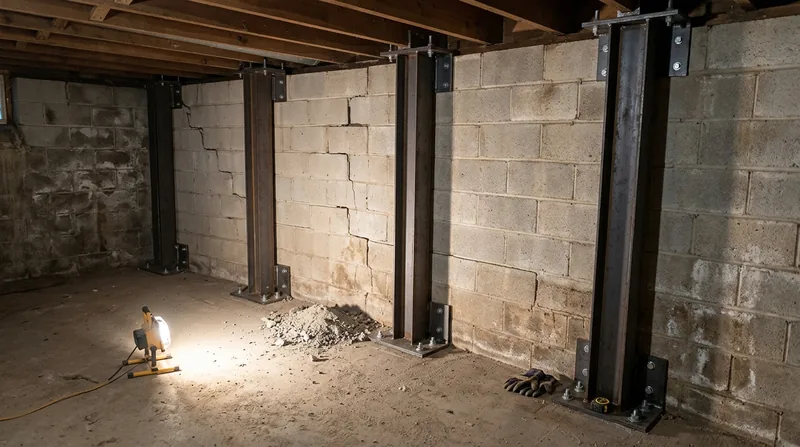




Bowing Wall Repair in Richmond: When Saturated Clay Pushes Back
If you own a home in Richmond, you know the ground here moves. The Fall Line puts us on a mix of Coastal Plain sands and clays to the east and Piedmont red clay to the west, and when a wet winter or a summer thunderstorm saturates that clay, it presses hard against older block and brick basement walls. Bowing Wall Repair in Richmond is the work of stopping that inward movement before a wall leans far enough to crack the floor slab or drop the joists above it. We see it most in 1900s to 1930s foursquares and 1950s to 1970s brick ranches across Henrico and Chesterfield, where block walls were laid with little reinforcement against hydrostatic pressure. Our job is to figure out whether the wall is still moving and then lock it in place with carbon fiber straps, steel I-beams, or wall anchors matched to your soil and the severity of the bow. If you have already noticed foundation crack repair needs alongside the bow, we scope the two together so the repair is not half done.
Why Bowing Walls Are a Richmond Problem, Not a Cosmetic One
The dominant failure mode here is saturated Piedmont clay pressing on older basement walls. Richmond gets heavy rain from summer thunderstorms and hurricane remnants like Gaston in 2004, and the red clay west of the city holds that water for days. A block wall that was plumb in 1955 can show a visible belly by the time a homeowner notices efflorescence or a horizontal crack at mid-height. The bow is the symptom; the hydrostatic pressure behind the wall is the cause.
- Clay soil swells when wet and pushes inward on the wall, then shrinks in dry spells and leaves the wall unsupported.
- Older brick and granite foundations in Church Hill and the Fan were laid in soft lime mortar that gives way before the brick does.
- Hillside runoff on the river bluffs in Forest Hill and Westhampton adds pressure from above, not just from the side.
- Clogged footing drains and short downspouts keep water against the foundation instead of moving it away.
A bow that measures a quarter inch today can grow past an inch in a single wet season, so the measurement matters more than the look of the wall.
Key info: A 1920s foursquare off Monument Avenue in the Museum District came in with a block wall bowed about 1.5 inches at mid-height after a wet spring. The homeowner had only noticed paint flaking. We found the horizontal crack and efflorescence line that told us the wall had been moving for years.
For the official side of structural repair permits in the city, start with the Richmond Department of Planning and Development Review before any wall stabilization work begins.
How We Diagnose and Stabilize a Bowing Wall in Richmond
We do not quote a strap count over the phone. A bowing wall repair starts with a walkthrough of the basement and the grade outside, because the fix depends on whether the wall is still moving and what is driving the pressure. On a 1990s Colonial in Short Pump with a poured-concrete wall, the answer is often different from a 1920s rowhouse in Jackson Ward with an English basement on brick. We measure the bow, check for horizontal cracking and floor slab separation, and look at the drain tile and grading on the wet side.
- We map the wall with a string line and tape to record the actual deflection at mid-height and at the top plate.
- We inspect the footing drain, downspout discharge, and grade to see where water is collecting against the foundation.
- We recommend carbon fiber straps for a stable wall with moderate bow, or steel I-beams and wall anchors when the wall is still active.
- We pull the permit where the local building department requires it for structural foundation repair.
- We install the system, then re-measure the wall and document the before and after for your records.
The right system is the one matched to your soil and the amount of movement, not the one that is easiest to sell.
Key info: A split-level in Lakeside had a block wall bowing toward the basement with the top plate still straight. Carbon fiber straps across the affected bays stopped the movement without excavation. A similar bow in Bon Air on a deeper wall needed steel I-beams because the clay was still active. Same symptom, different answer.
If the inspection shows water is the driver, we bring in the interior drain tile system so the wall is not fighting a wet footing after the straps go on.
Bowing Wall Repair Methods We Use in Richmond
There is no single fix for a bowing wall. The method follows the severity of the movement, the wall material, and how much hydrostatic pressure the soil is putting on it. Here is how the main approaches compare on Richmond-area homes.
| Approach | Description | Best for |
|---|---|---|
| Carbon fiber straps | Straps bonded vertically to the wall and anchored at the floor and top plate to resist further inward movement. | Stable walls with moderate bow and no active movement. |
| Steel I-beams | Vertical steel beams set against the wall and tied into the floor and joists to hold the wall plumb. | Larger bows and block walls that are still moving. |
| Wall anchors | Earth anchors set outside the wall and connected through the wall to a plate that pulls it back over time. | Walls with room outside and a bow that can be straightened gradually. |
| Epoxy or polyurethane injection | Cracks filled under pressure to close the leak path before or after stabilization. | Crack sealing on walls that are not structurally bowing. |
We choose the method after the measurement, not before, because the wrong system wastes money and leaves the wall moving.
Bowing Wall Repair Cost in Richmond: What to Expect
Homeowners ask for a number before they ask anything else, so here is the honest shape of it. Bowing wall repair starts at $600 for a small, straightforward stabilization scope, and most full wall repairs on Richmond-area basements land well above that once the strap count, wall length, and access are factored in. The cost moves with the size of the wall, how many bays are affected, whether the wall is block or poured concrete, and how much excavation the chosen method requires.
Two or three estimates is not overkill. A contractor who measures the bow and explains the method is giving you a real number. One who quotes straps over the phone without looking at the grade outside is guessing. Ask each one whether the wall is still moving, because that answer changes both the method and the price.
Our full pricing overview breaks down the ranges by method so you can compare bids on the same basis.
Bowing Wall Repair Near Me: How to Choose a Contractor Near Richmond
When you search for bowing wall repair near me in Richmond, the list of names is long and the differences are not obvious from a website. A few checks will separate a specialist from a general handyman. Ask for proof of insurance, ask how they measure a bow, and ask whether they pull the permit themselves.
- Confirm the contractor is licensed and insured for structural foundation work in Virginia, and ask for a certificate of insurance.
- Get at least two or three written estimates that name the method and the number of straps or beams.
- Ask for references from Richmond-area jobs with the same wall material and a similar bow.
- Confirm who pulls the permit, because structural foundation repair commonly requires one and the rules vary by jurisdiction.
- Check HOA requirements in subdivisions across Short Pump and Glen Allen before work starts, since some associations have their own notification rules.
A contractor who answers these plainly is the one worth letting into your basement.
To set up an inspection, reach us through the contact page or call (804) 525-9678 and we will schedule a look at the wall.
Bowing Wall Repair in Richmond: Pricing Guide
| Service | Price | Details |
|---|---|---|
| Carbon fiber strap stabilization | Starting at $600 | Covers a small stabilization scope with a limited strap count; wall length and bay count move the price. |
| Steel I-beam wall stabilization | Starting at $1,800 | Includes beam installation tied into floor and joists; wall height and access drive the final figure. |
| Wall anchor system | On estimate | Needs an outside look at soil and clearance before a number is given. |
| Crack injection before stabilization | Starting at $450 | Epoxy or polyurethane injection on the crack path; crack length and wall thickness move the cost. |
| Travel | Included | In Richmond and surrounding areas, no separate call-out or mileage fee. |
| Estimate | Free | Response within 24h at (804) 525-9678, no obligation to book. |
Indicative pricing, the exact cost depends on square footage, finish, and site access. Free personalized estimate within 24h at (804) 525-9678.


