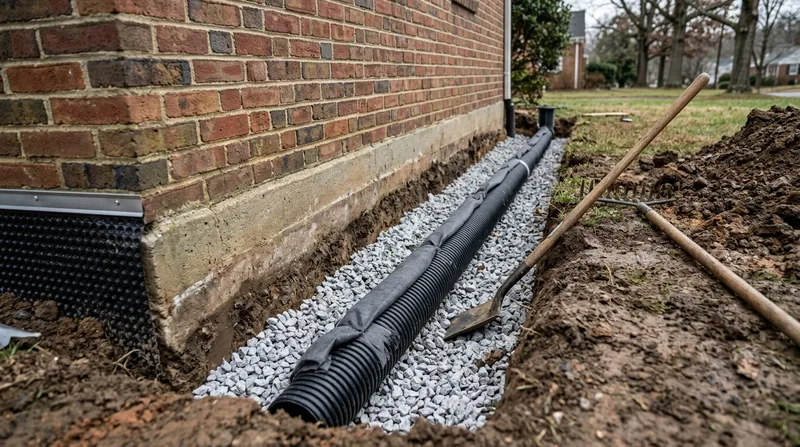




French Drain Installation in Richmond is the exterior line of defense for homes sitting on the Fall Line, where the James River drops over granite rapids and the ground changes character from one block to the next. East of the city you get Coastal Plain sands and clays with a high water table; west of it you get Piedmont red clay and saprolite that sheds water slowly. Homes in Church Hill and the Fan sit on old brick foundations laid in soft lime mortar, while Short Pump Colonials sit on poured-concrete walls. Both read the same signal when a storm rolls through: water stacking against the footing. A properly graded exterior drain intercepts that groundwater before it reaches the wall, and we install them across the metro. If you want the full picture of how exterior drainage fits with wall sealing and footing work, start with our exterior basement waterproofing page.
Why Richmond Lots Push Water Against the Foundation
The metro's terrain is the reason so many basements here stay damp. The river bluffs in Forest Hill and along Riverside Drive send hillside runoff downhill fast, and it piles up at the lowest wall. In Shockoe Bottom and Manchester, floodplain lowlands keep the water table close to the footing year round. Out in Henrico and Chesterfield, the red clay holds water like a shallow pan after a summer thunderstorm.
- Hydrostatic pressure builds against the wall when saturated clay cannot drain, and it finds every mortar joint in a 1900s foursquare.
- Roof downspouts that dump within three feet of the foundation turn a dry wall into a wet one during hurricane remnants like Gaston in 2004.
- Grading that slopes back toward the house channels surface water straight into the foundation line.
- Original weeping tile around 1920s foundations has often collapsed or silted shut, so the footing drain no longer moves water.
When two or more of those conditions show up on the same property, an exterior drain is usually the right first move rather than repeated patching.
Key info: On a Bellevue bungalow we inspected last spring, the downspouts discharged right at the corner and the yard sloped back to the wall. The basement stayed dry for years until a heavy June storm, then took on two inches. The fix was a perimeter drain with proper discharge, not a new coat of sealer.
Drainage work that alters how stormwater leaves a property can fall under local rules, so confirm the specifics with the City of Richmond planning and development review office before digging.
How We Install a French Drain on a Richmond Foundation
We start by reading the lot, not the catalog. That means checking where the grade falls, where the water table sits, and how the existing footing drain is performing. On a Tuckahoe split-level the answer is often a shallow exterior run to daylight; on a Windsor Farms Georgian with a deep basement, the drain may need to tie into a sump basin instead.
- We walk the property and mark the high side, the low side, and every downspout outlet before any digging starts.
- We excavate a trench along the foundation wall to the footing depth, keeping clear of mature willow oaks and magnolias whose roots we intend to leave intact.
- We line the trench with filter fabric, then set washed gravel and perforated pipe with the holes facing down.
- We wrap the gravel in fabric to keep Piedmont clay from silting the pipe, then backfill in lifts and compact.
- We discharge to daylight on a sloped lot, or into a sump basin with a check valve and discharge line where gravity will not carry the water.
- We restore grade so the finished soil slopes away from the wall, and we extend downspouts well past the trench line.
Every run is tested with water before we backfill the last section, because a drain that has not been flow tested is just a guess.
Key info: A Forest Hill home on a steep bluff lot had water entering at the rear wall every time a summer storm stalled over the river. We ran a graded exterior drain along the uphill side to daylight at the street, and tied the downspouts into it. The wall stayed dry through the next hurricane remnant.
If the drain has to feed a sump basin, the pump and its backup are part of the same system, and our sump pump installation work covers that connection.
Exterior Drain Approaches We Use Across the Metro
Not every lot takes the same configuration. The table below shows the approaches we use most often and where each one fits best, based on what we find on site.
| Approach | Description | Best for |
|---|---|---|
| Gravel and perforated pipe to daylight | Fabric-wrapped trench along the wall, discharging by gravity to a lower point on the lot. | Sloped lots on the river bluffs and hillside properties in Forest Hill. |
| Drain tied to a sump basin | Perimeter run feeding a basin with a pump, check valve, and discharge line. | Flat lots in the Fan and Shockoe Bottom where gravity will not carry water away. |
| Shallow curtain drain uphill | A drain set above the footing to intercept hillside runoff before it reaches the wall. | Properties with a steep uphill grade and runoff sheeting toward the house. |
| Footing drain replacement | Removing failed original weeping tile and installing new pipe and gravel at the footing. | Pre-1950 homes where the original clay tile has collapsed or silted shut. |
| Downspout tie-in and regrade | Extending downspouts past the trench and reshaping soil to slope away from the wall. | Homes where surface water, not groundwater, is the main source of seepage. |
We pick the approach that matches the lot and the foundation, not the one that is easiest to sell.
French Drain Installation Cost in Richmond: What to Expect
Most exterior drain work in the Richmond market starts around $25 per linear foot and moves up from there. That starting figure covers a standard gravel and pipe run along the wall with fabric wrap and basic discharge. The variables that push the number higher are the ones you can see on site: trench depth, how much concrete or hardscape has to come out, and whether the run ties to a sump basin.
- Footing depth drives cost, since a deep basement in Windsor Farms means a deeper trench and more excavation time.
- Access matters, and a narrow side yard in the Fan or Jackson Ward slows the work compared with an open lot in Midlothian.
- Mature trees near the run add time, because we work carefully around roots rather than cutting through them.
- Discharge to daylight is cheaper than a sump basin with a pump, check valve, and discharge line.
- Failed original weeping tile that has to be removed and replaced adds labor on pre-1950 foundations.
Two or three written estimates from local contractors is the smart way to compare, because scope varies as much as price. Our full pricing overview lays out the detail behind these figures.
Hiring a French Drain Contractor Near Me in Richmond: What to Check
Drain work is mostly invisible once the trench is backfilled, so the vetting happens before anyone digs. Ask for the license and insurance certificate, not just a verbal assurance. Call two references from jobs at least a year old, and ask whether the basement stayed dry through a heavy storm. Confirm who pulls any required permit, and get the discharge point in writing.
- Verify the contractor is licensed and insured, and ask for the certificate to be sent directly.
- Get two or three estimates in writing so you can compare scope, not just the bottom line.
- Ask for references from similar Richmond neighborhoods, since a Church Hill cellar and a Short Pump basement are different jobs.
- Confirm the permit responsibility for any drainage work that touches the storm or sanitary connection.
- Check for HOA rules on discharge points and excavation in common areas before scheduling.
We are a Basement Health Association member and we are glad to walk you through any of this before you sign. Reach us through our contact page when you are ready to talk.
French Drain Installation Near Me: Signs You Need One
Homeowners usually call us after a storm, not before. The pattern is consistent: water appears at the base of the wall within a day of heavy rain, the stain climbs a little each season, and efflorescence shows up as a white powder on the brick. In older Richmond homes the first sign is often a musty smell in the basement that never quite goes away.
- Water seeps in at the wall base after rain, which points to hydrostatic pressure rather than a single crack.
- Efflorescence appears on the lower wall, showing that moisture is moving through the masonry.
- The sump pump runs constantly during storms or has failed outright, which signals more water than the system was sized for.
- Downspouts discharge at the foundation and the yard slopes back toward the house.
A free basement inspection tells you which of these is happening and whether a drain is the right answer. If the real problem is a single open crack, we will say so and point you to foundation crack repair instead.
French Drain Installation in Richmond: Pricing Guide
| Service | Price | Details |
|---|---|---|
| Exterior drain to daylight | Starting at $25/linear ft | Includes trench, fabric wrap, gravel, perforated pipe, and gravity discharge to a lower point. |
| Drain tied to sump basin | Starting at $40/linear ft | Adds basin, pump, check valve, and discharge line where gravity will not carry water. |
| Footing drain replacement | On estimate | Requires removing failed original weeping tile and rebuilding the run at the footing. |
| Travel | Included | In Richmond and surrounding metro areas, with no separate call-out or mileage fee. |
| Estimate | Free | On-site assessment and written scope, response within 24 hours at (804) 525-9678. |
Indicative pricing, the exact cost depends on square footage, finish, and site access. Free personalized estimate within 24h at (804) 525-9678.


