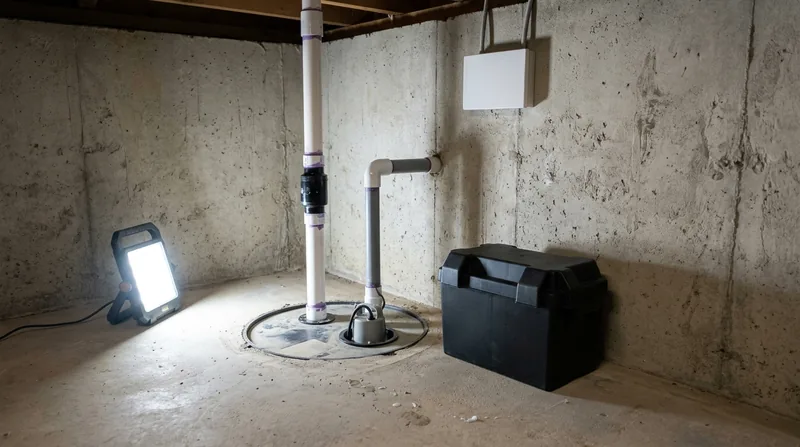




Battery Backup Sump Pumps in Richmond: Power Outages Do Not Wait
Richmond sits on the Fall Line, where the James River drops over granite rapids and the ground changes fast from Piedmont red clay and saprolite on the west side to Coastal Plain sands and clays with a high water table on the east. That means a working sump pump is already carrying real weight in basements across the Fan, Church Hill, Bellevue, Forest Hill, and out through Henrico and Chesterfield. The problem is that the storms which fill your sump basin are the same storms that knock out the grid. Battery Backup Sump Pumps in Richmond keep water moving out of the pit when the primary pump goes silent, and they are the cheapest insurance you can put on a finished basement. If you already run a primary pump, see our sump pump installation and replacement page for the full setup. If your pit is dry and you are starting from scratch, start with a free basement inspection so we can size the system to the actual inflow.
Why Battery Backup Sump Pumps Matter in Richmond's Old Brick Cellars and New Poured Basements
Richmond gets hammered by summer thunderstorms and by hurricane remnants like Gaston in 2004, and the failure mode that dominates here is simple: the primary pump loses power exactly when the water table is climbing. In the Fan and Jackson Ward, English basements sit on old brick or granite foundations laid in soft lime mortar, and a pit that overflows pushes water against walls that were never meant to hold it back. In Short Pump and Midlothian, poured-concrete basements are tight, but a dead pump still means a flooded floor and soaked drywall within an hour of a heavy cell.
- Power loss during storms is the number one cause of sump failure, and it always coincides with peak inflow.
- High water table in the eastern Coastal Plain keeps the pit filling even after the rain stops.
- Hillside runoff on the river bluffs and in Tuckahoe sends water to the footing drain faster than a single pump can move it.
- Older primary pumps in 1950s to 1970s Henrico ranches often run past their service life without any warning.
- Frozen or blocked discharge lines during a January thaw can back water into the basin with the backup running.
A backup pump does not replace the primary. It buys you the hours you need to get power back or get a generator running.
Key info: A homeowner in Bellevue lost power for nine hours during a July storm and came back to four inches of water across a finished basement. The primary pump was fine. The grid was not. A battery backup with a float alarm would have kept the pit dry.
For the official word on storm preparedness and power outages in the region, Ready.gov publishes plain-language guidance that applies directly to sump pump planning.
How We Size and Install a Battery Backup Sump Pump in Richmond
We do not drop a one-size box into every pit. A backup system has to match your basin diameter, your primary pump's float height, your discharge line diameter, and the actual inflow your pit sees during a storm. We check the check valve, the discharge routing, and whether the line exits above grade before we quote anything. Then we test the backup under load, not just on a bench.
- We inspect the existing sump basin, pump, float, and check valve to confirm the pit can accept a backup unit.
- We measure inflow during a wet period or simulate it, so the backup battery and pump are sized to real conditions.
- We install the backup pump on its own float, tied into the same discharge line through a dedicated check valve.
- We mount the battery and charger in a dry, accessible spot and wire the alarm to a location you will actually hear.
- We run a full cycle test, confirm the alarm triggers, and walk you through the maintenance schedule.
If your pit is undersized or your discharge line is the real problem, we will tell you before we sell you a battery.
Key info: A 1920s foursquare in Ginter Park had a 15-inch basin and a discharge line that ran into a flower bed. The backup pump worked, but the line backed up. We rerouted the discharge to a proper extension and the system has run clean through three storm seasons.
If your pit needs a full rebuild before a backup goes in, our interior drain tile system page covers how the basin ties into the perimeter drain.
Backup Sump Pump Options We Install in Richmond
| Approach | Description | Best for |
|---|---|---|
| Battery backup pump in existing pit | A DC backup pump with its own float, mounted beside the primary and tied into the discharge line through a separate check valve. | Homes with a working primary pump and a basin large enough for a second unit. |
| Combination primary and backup unit | A single assembly with an AC primary and a DC backup in one housing, sharing the same discharge. | Older pits in the Fan and Church Hill where space is tight and the primary is due for replacement. |
| Battery backup with high-water alarm | Backup pump plus a float alarm that sounds before the pit overflows, so you know the primary has failed. | Finished basements in Short Pump, Glen Allen, and Midlothian where early warning matters. |
| Backup with maintenance plan | Annual battery load test, float check, and discharge line inspection included with the install. | Homeowners who travel or who have lost power repeatedly during hurricane season. |
Every option above is tested under load before we leave, and every install includes a walkthrough of the alarm and battery check.
Battery Backup Sump Pumps Cost in Richmond: What to Expect
Most battery backup installations in the Richmond market start at $900 and climb from there based on what your pit actually needs. The price moves with the size of the backup battery, whether we are adding a high-water alarm, whether the discharge line needs rerouting, and whether the existing primary pump has to be replaced at the same time. A tight pit in a Church Hill cellar takes more labor than a wide basin in a 1990s Short Pump colonial.
- Basin size and condition determine whether a backup fits beside the primary or needs a combination unit.
- Battery capacity drives cost more than the pump itself, and a larger battery buys more runtime.
- Discharge line routing can add labor if the line has to be extended or rerouted away from the foundation.
- Alarm and monitoring add-ons are inexpensive but change the total.
- Emergency scheduling during an active storm event may carry a premium.
Get two or three estimates and ask each contractor to explain what they are sizing the battery to. A quote that does not mention inflow or basin size is a guess. Our full pricing overview lays out the ranges for every service we run.
Hiring a Waterproofing Contractor Near Richmond: What to Check Before You Sign
Battery backup work is electrical and plumbing adjacent, so the contractor you hire should carry general liability and workers' compensation coverage and be able to produce a certificate on request. Ask for two local references from the last twelve months, ideally from a neighborhood with the same foundation type as yours. If the contractor cannot explain how they will size the battery to your pit, keep calling.
- Verify licensing and insurance before any work starts, and ask for the certificate in writing.
- Get multiple estimates and compare what is included, not just the bottom line.
- Check references from homes with similar pits and similar storm exposure.
- Ask about permits where the discharge alters drainage or ties into the sanitary connection, and confirm the local building department's current rules, which vary by jurisdiction.
- Confirm the warranty is transferable and in writing, and read what it actually covers.
We are a Basement Health Association member, and we will tell you when a backup pump is not the right answer for your pit. Reach out through our contact page to schedule a free estimate.
Battery Backup Sump Pumps in Richmond: Pricing Guide
| Service | Price | Details |
|---|---|---|
| Battery backup pump installed in existing pit | Starting at $900 | Includes DC backup pump, dedicated float, check valve, and full load test before we leave. |
| Combination primary and backup unit | Starting at $1,250 | Single housing with AC primary and DC backup, best for tight pits in older Richmond cellars. |
| Backup with high-water alarm | Starting at $1,050 | Adds a float alarm that sounds before the pit overflows, with the alarm mounted where you will hear it. |
| Discharge line rerouting | On estimate | Quoted after we trace the existing line and confirm where it exits relative to grade and foundation. |
| Estimate | Free | Response within 24 hours at (804) 525-9678, no obligation to book the work. |
Indicative pricing, the exact cost depends on square footage, finish, and site access. Free personalized estimate within 24h at (804) 525-9678.


