



If you own a home in Richmond's Fan, Church Hill, or Forest Hill, you already know the pattern: a summer thunderstorm dumps two inches in an hour on red clay and old brick, and by evening there's water in the basement. Basement Waterproofing in Richmond starts with understanding the Fall Line. West of the river, Piedmont red clay and saprolite hold water against your foundation. East of it, the water table sits high under Coastal Plain sands. Add 1840s lime-mortar cellars, 1920s foursquares, and poured-concrete basements in Short Pump, and there is no single fix. We trace the true water path, then build a system that matches your foundation, not a sales package. Start with a free basement inspection so we can see where the water is actually entering.
Why Richmond Basements Take On Water: Fall Line Terrain and Old Foundations
Richmond sits where the James River drops over granite rapids, and that geology decides how your basement behaves. In Shockoe Bottom and Manchester, floodplain lowlands push water against foundations after heavy rain. On the bluffs above the river, hillside runoff finds every crack. In the Fan and Jackson Ward, English basements sit on brick footings laid in soft lime mortar that has been wicking moisture for a century. Hurricane remnants like Gaston in 2004 showed how fast a saturated clay slope can overwhelm a footing drain.
- Hydrostatic pressure builds under red clay west of the Fall Line and forces water through lime-mortar joints and cold pours.
- A high water table east of the Fall Line keeps sump basins full and makes sump pump failure a real risk during summer storms.
- Old brick foundations in Church Hill and the Museum District wick water upward, leaving efflorescence and a musty basement smell.
- Downspouts that dump at the wall and grading that slopes back toward the house send roof water straight into the basement.
- 1990s and newer Colonials in Short Pump and Midlothian crack at cold joints and form tie-rod holes that seep under heavy rain.
The failure mode that dominates in Richmond is hydrostatic pressure after heavy rain, not a single isolated crack, so we diagnose the whole water path before we quote any work.
Key info: A 1912 foursquare in Lakeside with efflorescence on the lower block and a damp rug after every storm usually needs an interior perimeter drain, not another coat of sealer on the inside wall.
For the official word on permits and contractor requirements, the City of Richmond planning and development review office is the authority to check before any structural or drainage work begins.
How We Waterproof a Richmond Basement: Diagnose, Drain, Seal, Verify
We start at the source. A technician walks the exterior grade, checks downspout discharge and window wells, reads the crack patterns inside, and tests whether the sump basin fills during a controlled hose run. From there we choose interior or exterior work based on where the water is coming from, not on what is easiest to sell. If simple epoxy injection closes a non-structural crack, we say so and stop there. If the wall is bowing or the footing drain is clogged with clay, we build the heavier system.
- We map the water path from gutter, grade, and soil down to the footing and sump basin.
- We core and install an interior drain tile system with a sump basin and check valve where hydrostatic pressure is the driver.
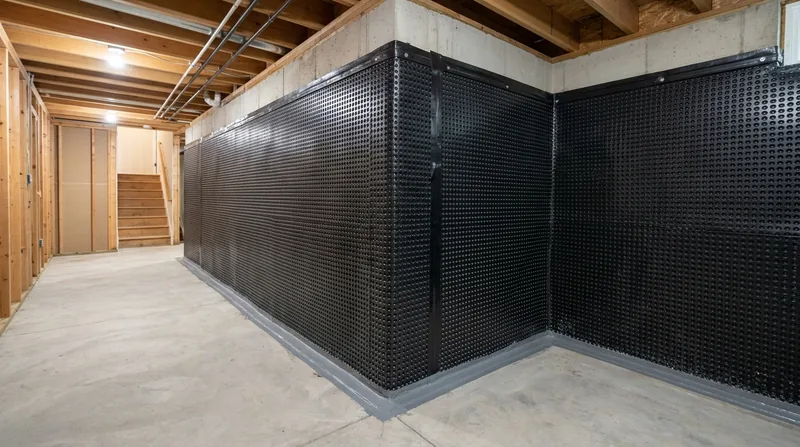
- We excavate and re-apply a waterproof membrane and dimple board on exterior walls where the outside is the right answer.
- We inject structural cracks with epoxy or polyurethane through sealed injection ports.
- We correct grading, extend downspouts, and seal the wall with a vapor barrier and basement wall sealing where moisture is vapor-driven.
- We run a water test and verify the sump pump, discharge line, and battery backup before we leave.
Every job ends with a written record of what we found, what we installed, and what to watch for in the next rainy season.
Key info: On a 1925 Tudor in Ginter Park, the crack at the rear wall was cosmetic after epoxy injection, but the wet floor along the front came from a failed footing drain. Two different fixes, one visit.
When the problem is inside the basement, we install an interior drain tile system because it works without digging up established landscaping or magnolias in a Westhampton yard.
Waterproofing Approaches We Use in Richmond Homes
Each method below solves a different water problem, and most Richmond basements need a combination rather than a single product. We match the approach to the foundation type, the soil, and the way water actually enters. The table is a starting point, not a menu.
| Approach | Description | Best for |
|---|---|---|
| Interior drain tile system | Weep holes and a perimeter channel under the slab lead water to a sump basin. | Hydrostatic pressure and wet floors after heavy rain |
| Exterior waterproofing | Excavation, membrane, dimple board, and footing drain replacement. | Failed footing drains and bowing walls on the river bluffs |
| Crack injection | Epoxy or polyurethane forced through injection ports into the crack. | Non-structural cracks in poured concrete and block walls |
| Wall sealing and vapor barrier | Parging repair, sealer, and a vapor barrier over damp masonry. | Efflorescence and musty basement smell in old brick cellars |
| Sump pump and battery backup | Primary pump, check valve, discharge line, and backup power. | High water table east of the Fall Line and storm outages |
We tell you plainly when a crack repair is enough and when an interior drain tile system is the better answer than exterior excavation, because the wrong system wastes money and still leaves water on the floor.
Basement Waterproofing Cost in Richmond: What to Expect
Most Richmond homeowners start asking about cost right after the first wet basement, and the honest answer is that a small crack injection and a full interior perimeter drain are not in the same range. We quote from $2,500 as a starting point for a focused repair, with interior drain tile systems, sump pump replacement, and exterior excavation moving up from there. The number depends on linear feet of wall, foundation material, access, and how much of the water path is outside the house.
- Foundation type matters: a poured-concrete basement in Short Pump is faster to core than a 1900s brick cellar in Church Hill.
- Linear feet of drain tile and the number of sump basins drive the bulk of the interior system price.
- Exterior excavation costs more because of digging, soil disposal, and restoring grade and plantings.
- Crack injection is priced per crack, and structural cracks that need carbon fiber straps or wall anchors add scope.
- Urgency matters: an emergency call during a storm is not the time to compare quotes carefully.
Get two or three estimates, ask each contractor to explain the water path they found, and compare the scope line by line rather than the bottom number alone. Our full pricing overview breaks down the ranges by system so you can read quotes with context.
Finding a Basement Waterproofing Contractor Near Me in Richmond
The right contractor near Richmond will walk your basement, ask about the last storm, and explain why water is entering before quoting a system. Use the same checklist you would for any trade: verify the license, ask for a certificate of insurance, and call two recent references in your part of the city. A contractor who only sells one system, or who promises a lifetime warranty in writing before seeing the wall, is a warning sign.
- Confirm the company is licensed and insured, and ask for the certificate before work starts.
- Get two or three written estimates that describe the same scope so you can compare fairly.
- Ask whether permits are needed for structural foundation repair, egress window cutting, or altering the sump discharge connection, and confirm the local building department's rules.
- Check references in neighborhoods with your foundation type, from old brick in Jackson Ward to 1970s brick ranches in Henrico.
- Ask what the transferable warranty covers and get it in writing before you sign.
We are a Basement Health Association member, and we put the scope, the warranty terms, and the water test results in writing so there is no guessing later. Reach out through our contact page to schedule a free inspection, or call (804) 525-9678 and we will respond within 24 hours.
Basement Waterproofing in Richmond: Pricing Guide
| Service | Price | Details |
|---|---|---|
| Crack injection (epoxy or polyurethane) | Starting at $2,500 | Includes injection ports, sealing, and water test; price moves with number and length of cracks |
| Interior drain tile system with sump basin | Starting at $4,800 | Perimeter channel, sump basin, check valve, and discharge line; linear feet of wall drives the price |
| Exterior basement waterproofing | On estimate | Excavation, membrane, dimple board, and footing drain; access and soil disposal need an on-site look |
| Sump pump replacement with battery backup | Starting at $1,200 | Primary pump, backup power, check valve, and discharge line; basin condition can add scope |
| Travel | Included | In Richmond and surrounding areas, no separate call-out or mileage fee |
| Estimate | Free | Response within 24h at (804) 525-9678, no obligation to book |
Indicative pricing, the exact cost depends on square footage, finish, and site access. Free personalized estimate within 24h at (804) 525-9678.


