



Vapor Barrier Installation in Richmond: Stop Ground Moisture Before It Becomes a Wet Basement
Richmond sits on the Fall Line, where the James River drops over granite rapids and the ground shifts from Coastal Plain sands and clays with a high water table on the east side to Piedmont red clay and saprolite on the west. That split geology means basement moisture here rarely comes from one direction. In Church Hill and the Fan, English basements sit on old brick or granite foundations laid in soft lime mortar, and ground vapor moves straight through the masonry. Out in Short Pump and Midlothian, poured-concrete basements wick moisture up through the slab and walls. Vapor Barrier Installation in Richmond is the below-grade control layer that blocks that ground moisture vapor before it condenses on cool basement surfaces.
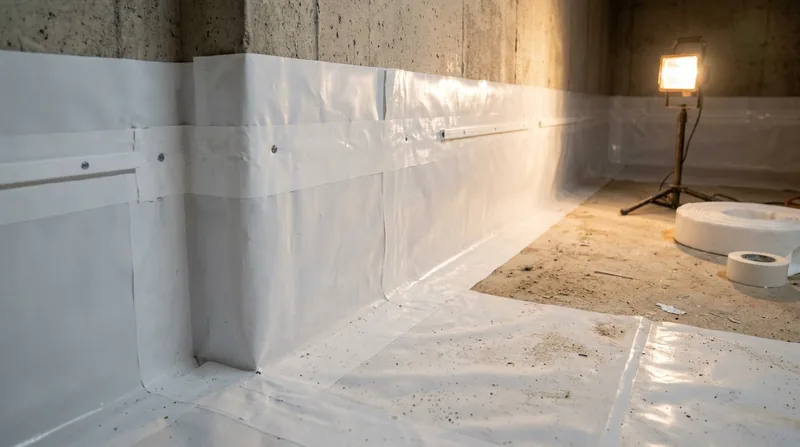
We install heavy-duty vapor barrier sheets across basement walls and the slab, seal every seam, tape the terminations, and integrate the sump basin where the floor drains. The result is a drier lower level with far less musty odor and no recurring efflorescence bloom on the block. If you are still diagnosing where the water is coming from, start with a free basement inspection so the barrier goes where it actually does the work.
Why Vapor Barrier Installation Matters in Richmond's Older and Newer Basements Alike
Richmond takes heavy rain, from summer thunderstorms to hurricane remnants like Gaston in 2004, and the humid summers keep basement air close to saturation for weeks at a time. In the Fan and Jackson Ward, that vapor drives through soft lime mortar and shows up as white efflorescence and a musty smell that never quite leaves. In the river bluffs and Shockoe Bottom lowlands, hillside runoff and a high water table push hydrostatic pressure against the wall, and vapor follows the same path.
- We block ground moisture vapor at the wall and slab rather than letting it condense on cool interior surfaces.
- We seal seams and tape terminations so the barrier stays continuous at corners, penetrations, and the floor-to-wall joint.
- We tie the barrier into the sump basin so any water that reaches the floor still reaches the pump.
- We leave the wall assembly able to dry toward the interior where the design calls for it, instead of trapping moisture behind an impermeable sheet.
A continuous barrier is what separates a basement that smells damp all summer from one that stays usable.
Key info: A 1920s foursquare in Bellevue with a full basement on old brick will pull vapor through the mortar joints all summer. Sealing the wall alone does not stop it. A properly lapped and taped vapor barrier over a dimple board drainage plane does, and it keeps the wall face dry enough that efflorescence stops recurring.
For the official word on basement moisture and foundation guidance, the City of Richmond publishes permit and inspection information that applies to any work altering drainage at the foundation.
How We Install Vapor Barriers in Richmond Basements
We start by finding the moisture source, not by hanging plastic. On a 1950s brick ranch in Henrico, that might mean confirming the slab is wicking rather than the wall leaking at a cold joint. On a 1990s Colonial in Short Pump, it usually means checking the footing drain and sump before we close the floor. Once the diagnosis is clear, the install follows a fixed sequence.
- We clear the basement perimeter and inspect the wall face, the floor joint, and the sump basin for active seepage.
- We address any open crack first with foundation crack repair so the barrier is not covering a leak.
- We install dimple board against the wall as a drainage plane and capillary break.
- We hang heavy-duty vapor barrier sheets with a consistent lap and seal every seam with the specified tape.
- We tape terminations at the rim, at penetrations, and at the floor-to-wall joint, and we integrate the sheet into the sump basin.
- We test the sump and check the discharge line before we call the job done.
Every step is checked against the wall, not against a checklist on a clipboard.
Key info: A Forest Hill Craftsman bungalow on a partial basement had efflorescence across the entire south wall and a musty odor that returned every July. The wall was wicking, not leaking. We installed dimple board and a sealed vapor barrier tied into the existing sump, and the wall face stayed dry through the next thunderstorm season.
If the floor is wet rather than the wall, the better answer is usually an interior drain tile system under the slab, with the vapor barrier as the finish layer above it.
Vapor Barrier Approaches We Use in Richmond
The right assembly depends on the foundation type, the moisture path, and whether a drainage system is already in place. These are the four approaches we specify most often in the Richmond metro.
| Approach | Description | Best for |
|---|---|---|
| Wall vapor barrier over dimple board | Dimple board against the wall as a drainage plane and capillary break, with a sealed vapor barrier sheet over it. | Brick and block walls wicking vapor in the Fan, Church Hill, and Bellevue. |
| Slab vapor barrier | Heavy sheet over the floor, lapped and taped, terminated at the wall joint and the sump basin. | Poured-concrete basements in Short Pump, Midlothian, and Glen Allen with slab wicking. |
| Full perimeter wall and slab barrier | Continuous wall and floor assembly with sealed seams, taped terminations, and sump integration. | Homes with both wall seepage and a damp slab, common in 1900s to 1930s foursquares. |
| Barrier integrated with a drain system | Vapor barrier installed above a new interior perimeter drain and sump basin. | Basements with active water at the floor joint and hydrostatic pressure on the wall. |
Vapor Barrier Installation Cost in Richmond: What to Expect
Vapor barrier work is priced by the square foot of wall and floor covered, and rates start from $3/sq ft in the Richmond market. A single wall in a small English basement in Jackson Ward is a modest job. A full perimeter install in a deep Windsor Farms basement with dimple board, sump integration, and sealed terminations is a much larger one.
- Wall area and floor area drive the material and labor total more than anything else.
- Dimple board, seam tape, and termination sealant add cost but are what make the barrier last.
- Access matters: a finished basement with stored furniture takes longer to clear and protect than a bare one.
- Sump integration and any crack repair done first add scope and cost.
- Older brick and granite foundations in the Fan and Church Hill need more detailing at irregular joints than poured concrete.
Get two or three written estimates on the same scope, and compare what is actually specified, not just the bottom line. Our full pricing overview lays out how we build a number.
Hiring a Vapor Barrier Installation Contractor Near Me in Richmond
Basement moisture work is easy to sell and hard to do right, so vet the contractor before you sign. Ask for proof of licensing and insurance, and have the certificate sent to you directly. Get at least two or three estimates and make sure each one describes the same assembly, the same lap, and the same terminations. Call references from jobs in Henrico, Chesterfield, or the city itself and ask whether the basement stayed dry through a full summer.
Permits are commonly required for structural foundation repair and for work altering drainage or the sanitary connection of a sump discharge, and thresholds vary by jurisdiction. Confirm the requirement with the local building department before work starts, and check any HOA rules if you are in a planned community. When you are ready to compare scope, contact us for a free estimate and we will walk the basement with you.
Vapor Barrier Installation in Richmond: Pricing Guide
| Service | Price | Details |
|---|---|---|
| Wall vapor barrier with dimple board | Starting at $3/sq ft | Includes dimple board, sealed laps, and taped terminations; wall height and joint irregularity move the rate. |
| Slab vapor barrier | Starting at $3/sq ft | Includes heavy sheet, sealed seams, and sump basin termination; floor clutter and access add labor. |
| Full perimeter wall and slab barrier | Starting at $4/sq ft | Continuous assembly with sealed seams and sump integration; finished basements take longer to protect. |
| Barrier integrated with interior drain | On estimate | Requires an on-site look to size the drain run, sump basin, and barrier together before quoting. |
| Travel | Included | In Richmond and surrounding areas, no separate call-out or mileage fee. |
| Estimate | Free | Response within 24h at (804) 525-9678, no obligation to book. |
Indicative pricing, the exact cost depends on square footage, finish, and site access. Free personalized estimate within 24h at (804) 525-9678.


